Regulatory Gambling Monitoring System (RGMS) for Government Authority
Centralised government wallet model ensuring 100% transaction visibility before operator fund release
Background
The government authority required a system to enforce complete oversight of all gambling activity in the jurisdiction, online and offline. The core principle: every gambling transaction must flow through a centralised government-controlled wallet before operators can access funds, ensuring tax compliance and enabling real-time regulatory monitoring. Before this, online and offline (casino terminal) activity could be reported through separate channels, which is precisely the gap that lets tax and oversight obligations slip.
What We Built
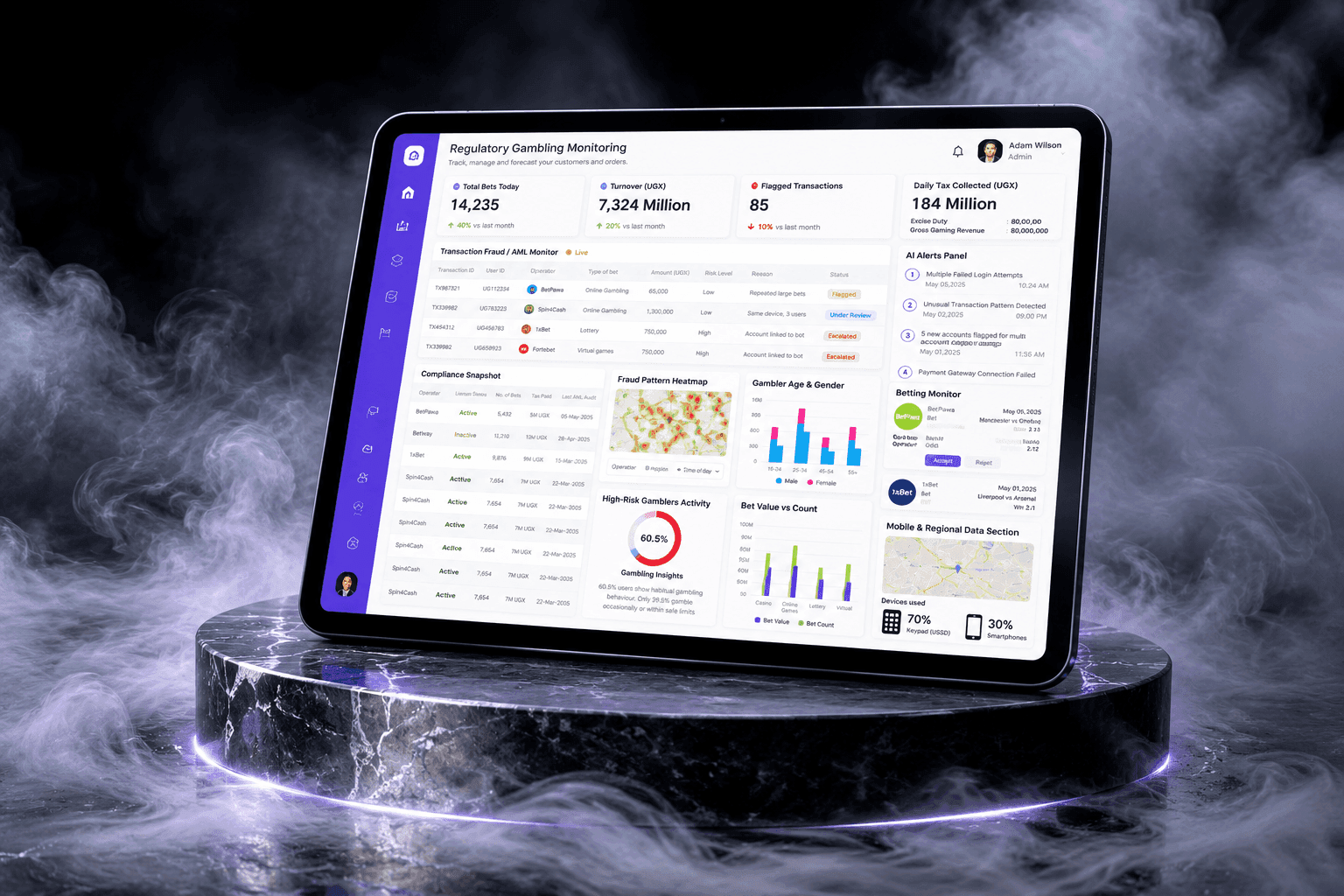
A full-stack regulatory platform implementing the Functional Specification Document (v2.0) for the RGMS. Key components:
- KYC & identity
- national ID, passport, and biometric (fingerprint and facial recognition) verification against national identity databases, using a checksum-validated UGRN format
- Government wallet
- centralised wallet per gambler; deposits, bets, and settlements all transit through these accounts
- Transaction processing
- real-time bet placement, settlement, and withdrawal processing with a full state machine
- Regulatory oversight
- live dashboard for the Gambling Regulatory Authority and Revenue Authority
- Tax automation
- automated deduction and remittance to the Revenue Authority on each settlement
- Dispute & fraud
- dispute resolution workflow and fraud detection rules engine
- Offline integration
- API for casino terminal real-time UGRN verification
Architecture
Microservices architecture separating identity, wallet, transaction, tax, and reporting concerns. PostgreSQL handles the financial transaction ledger (ACID compliance), which matters when the ledger is the government's own record of taxable activity. MongoDB stores KYC profiles and session data. Real-time API endpoints serve casino terminals directly.
Results
Online and offline gambling activity reportable through separate channels
Every transaction, online or at a casino terminal, routes through one government wallet
Outcomes & Lessons Learned
- Centralised government wallet model ensuring 100% transaction visibility before operator fund release
- KYC pipeline with biometric verification (fingerprint and facial recognition) completing within 24 hours
- UGRN (Unique Gambler Reference Number) system with checksum validation and national ID database verification
- Automated tax collection and real-time remittance to the Revenue Authority
- Dispute resolution and fraud detection engine with full audit trail per transaction
- Unified system covering both online and offline (casino terminal) gambling activity
The decision to require all transactions, including offline casino play, to route through the same centralised wallet eliminated a common evasion vector where online and offline activity could be reported separately. The checksum-validated UGRN format caught duplicate registration attempts at the API boundary before any database writes.
Questions, answered.
The things people ask us about this project. If yours isn't here, ask us directly, we reply like humans.
Ask us anything→Why must every transaction route through a centralised government wallet?
So every gambling transaction, online or at a casino terminal, is visible to the regulator before an operator can access the funds, which is what makes 100% transaction visibility possible rather than trusting operator-reported figures.
How is a gambler's identity verified?
Through a KYC pipeline with biometric verification, fingerprint and facial recognition, checked against national identity databases, using a checksum-validated Unique Gambler Reference Number (UGRN) format, completing within 24 hours.
Why use PostgreSQL for the transaction ledger when MongoDB is used elsewhere in the system?
The financial transaction ledger needs ACID compliance, since it's the government's own record of taxable activity, while KYC profiles and session data, which don't carry the same transactional guarantees requirement, are stored in MongoDB.
How does offline casino activity get included in the same oversight system?
Casino terminals connect via an API for real-time UGRN verification, so offline play routes through the same centralised wallet and oversight as online activity, closing a gap where the two could otherwise be reported separately.
How is tax collected and remitted?
Automated deduction and remittance to the Revenue Authority happens on each settlement, rather than being calculated and paid separately after the fact.
Ready to craft tomorrow, today?
Where innovation meets execution, and ideas evolve into impactful solutions. Book a free consultation, no strings attached.